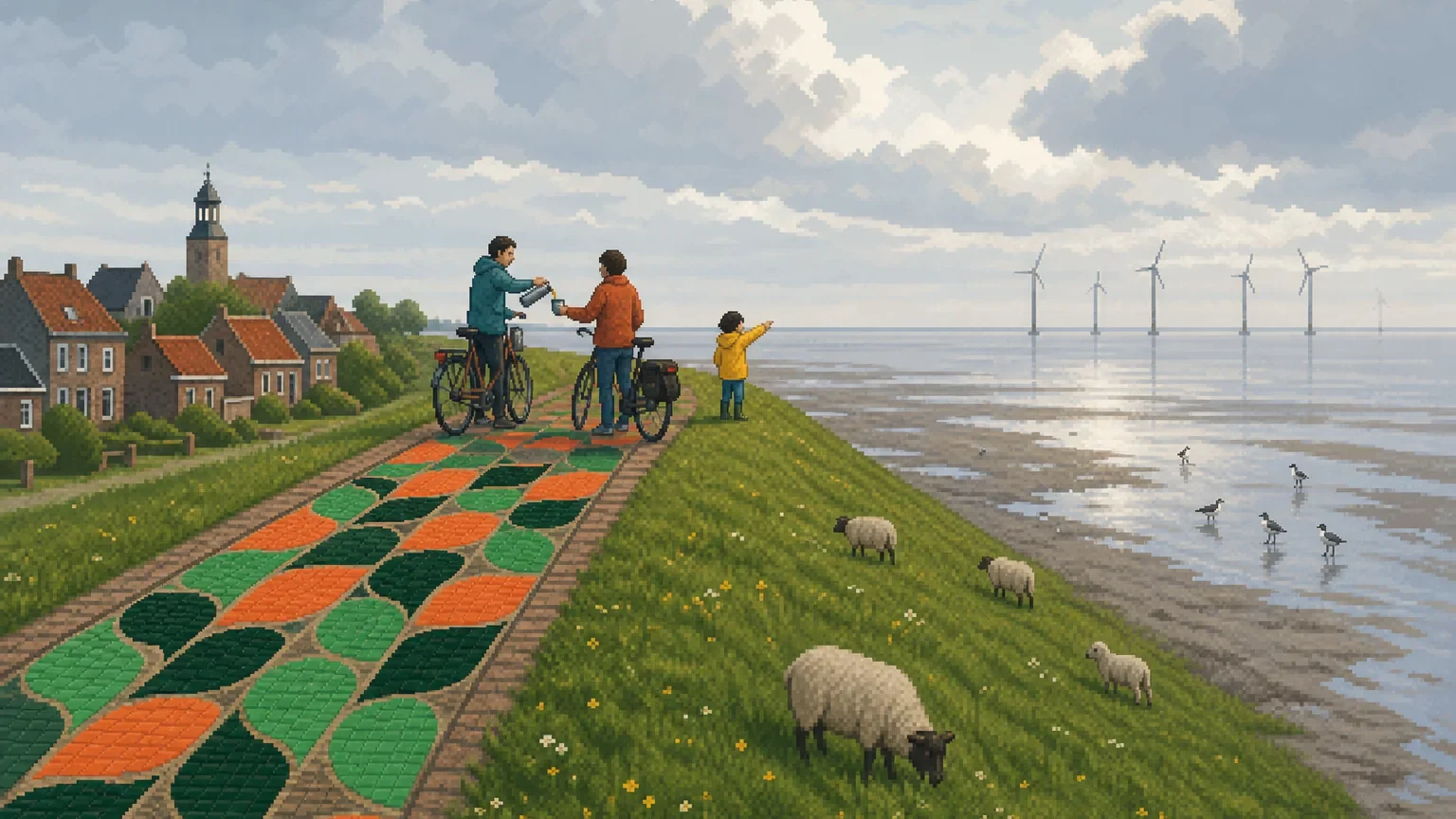
Dutch at a glance
Nederlands- Language code
- nl
- Text direction
- Left to right
- Register
- jij (informal), u (formal)
Regional variants and their hreflang values
nlDutch for every reader, written as the Dutch of the Netherlands (ships today)nl-BEDutch (Belgium), on the roadmap
Dutch is the language of the Netherlands and of Flanders, the northern half of Belgium, and Belgian Dutch differs from the Dutch of the Netherlands mostly in its choice of words. So the first decision for a Dutch version is usually how to address the reader, with the polite u or the familiar jij; choosing a regional variety, the first question for German, often comes later. A second, smaller one catches out designers: Dutch writes IJ as a pair, and some of your theme's styles may not.
LangRelay serves Dutch under the tag nl at /nl/, written as the Dutch of the Netherlands, and lets you fix u or jij once for the whole language.
U or jij#
Dutch has familiar forms of you (je, jij, and jullie for several people) and one polite form, u, for one person or many. The Flemish government's language advice service puts the line this way: use u with people you have no familiar relationship with, for example at first contact, and in formal written messages such as business correspondence; use je and jij once that relationship exists.
The choice reaches beyond the pronoun. The possessive follows it (uw with u, je or jouw with jij), and so does the verb. Two lines from a sign-in page show both:
- U: Heeft u een vraag? Log in met uw e-mailadres.
- Jij: Heb je een vraag? Log in met je e-mailadres.
Neither form is wrong for a website, but a site that uses both reads as careless. LangRelay's guidance is to pick the form your brand already uses in its Dutch emails and printed material, or u when you have none, and to keep it in the checkout, the account pages and every message the site sends.
IJ is one capital pair#
Dutch treats ij as a unit. When a word that starts with ij takes a capital, both letters do: IJsselmeer and IJmuiden, never Ijsselmeer. Unicode also has single-character ligatures, IJ and ij, but Wikipedia's article on the digraph notes that the recommended encoding is two ordinary letters, so text written with the ligature may not match a visitor's search for the same word.
The problem on a website is CSS. A theme that sets headings or buttons with text-transform: capitalize capitalizes the first letter of each word, which for Dutch gives Ijs instead of IJs. Browsers can apply the Dutch rule only when the element's language is marked as Dutch, and Wikipedia's article reports that, as of January 2021, only Firefox did so.
A worked example: a product heading#
This is a worked example. A café's menu page in English lists Iced tea, and its Dutch page lists ijsthee. Its theme writes product names in lowercase and lets CSS capitalize them, so the Dutch heading reads Ijsthee in any browser that does not apply the Dutch rule. Writing the capital into the text, IJsthee, and dropping the transform for that heading fixes it in every browser.
LangRelay's WordPress plugin sets lang="nl" on the <html> element of each Dutch page it serves, which is the condition any browser needs before it can apply Dutch rules. It does not change your theme's CSS, so check the headings and buttons your theme transforms on the Dutch pages; to check before pages go live, choose Ask me first.
The Netherlands and Belgium#
On a website, the two countries differ in some words and in how dates are written.
Some words differ. Wikipedia's article on Belgian Dutch gives examples where Belgian usage prefers a Dutch compound and the Netherlands a French loanword, such as droogzwierder for what the Netherlands calls a centrifuge, a spin dryer. It also notes that misdaad, a crime, is a legal term in Belgium and not in the Netherlands, which matters for terms and conditions.
Dates differ in form. JavaScript's Intl.DateTimeFormat, which uses the Unicode CLDR data, gives the short date for 7 October 2026 as 07-10-2026 for nl-NL and 7/10/2026 for nl-BE.
A separate Belgian version is worth having when the page itself has to differ, for example for Belgian legal text or prices with Belgian VAT. In LangRelay's locale model nl-BE would be a Target locale of its own, with its own /nl-be/ prefix, hreflang entry, translations and approvals, beside bare nl. Today a Site offers bare nl, and the Belgian version is on the roadmap. Until then, a single Dutch version serves readers in both countries, and the hreflang set lists it once as nl, with every version naming itself and the others as Google requires.
How LangRelay labels Dutch#
The bare tag nl stands for Dutch as written in the Netherlands, the Unicode CLDR default content for nl. LangRelay names that variety, Dutch (Netherlands), whenever it asks its translation engine for Dutch, so the engine never decides on its own whether to write for Amsterdam or Antwerp.
The Formality register is set under Settings, Languages. For Dutch it has three values: Formal (u), Informal (jij) and Language default, which leaves the choice to the engine. Saving a new value affects machine translations started afterwards. Pages already translated keep their wording, and so does any text a new page shares with them, until someone selects those rows in the Translation grid and asks for a Machine retranslate. When you ask Relay to review a page, it reports a line written in a different register from the rest of the page as a minor finding, so a stray je on a page in u shows up.
Questions about Dutch translations#
Does Dutch run longer than English?#
Dutch joins nouns into compounds, so a two-word English label can become one long word. Check narrow places such as buttons and table headers on a phone; to check before pages go live, choose Ask me first.
Do we write u with a capital?#
In the running text of a website, no: u is written lowercase, as in the examples the Flemish language service gives.
More on Dutch and LangRelay#
The WordPress translation guide covers installing the plugin, and French website translation covers a language with a regional version in Canada. For why a URL should not change language with the browser's settings, and what LangRelay offers those visitors instead, see the Accept-Language header. To set up Dutch on your own Site, book a demo.
Sources
The pages this one cites, with the day each was read.
- 01Vlaamse overheid, Team Taaladvies, je, jij / jullie / uvlaanderen.be, checked 7 October 2026
- 02Wikipedia, IJ (digraph)en.wikipedia.org, checked 7 October 2026
- 03Wikipedia, Belgian Dutchen.wikipedia.org, checked 7 October 2026
- 04MDN Web Docs, Intl.DateTimeFormatdeveloper.mozilla.org, checked 7 October 2026
- 05Google Search Central, Tell Google about localized versions of your pagedevelopers.google.com, checked 7 October 2026
- 06WordPress.org, LangRelay plugin (version 2.1.0)wordpress.org, checked 7 October 2026